
The Minister for Food and Agriculture, Eric Opoku has revealed government’s plan of implementing an import quota policy which directly links the privilege of importing rice to the growth of domestic production.
The Minister made this statement at the West African Rice Investment Roundtable where he explained that the policy,when introduced willl see to rice importers in Ghana being required to demonstrate verifiable procurement of and partnership with Ghanaian rice producers before import permits are approved.
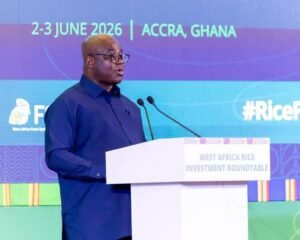
“That is why I am announcing a second decisive measure today. Government will implement an import quota policy that directly links the privilege of importing rice to the growth of domestic production.Under this policy, rice importers will be required to demonstrate verifiable procurement of and partnership with Ghanaian rice production before import permits are approved.” He stated
Eric Opoku added that the government is doing this not to “raise tariffs that punish consumers.”
But it rather aims at “redirecting the existing value in the rice trade towards building our own productive capacity.”
Adding that “the import share will reduce progressively over the next 10 years, but each reduction will be contingent on verified milestones in domestic production.”
According to Ministry analysis, this structured phase-out offers a credible pathway to 100% rice self-sufficiency within a decade. The economic dividends of the shift are projected to be massive: saving Ghana an estimated $2.1 billion in cumulative foreign exchange, mobilizing $400 million in private investment, and creating more than 200,000 jobs spanning farming, processing, and distribution.
“So where does this take us to? Our analysis shows a credible pathway to 100% rice self-sufficiency within 10 years. That pathway will save Ghana an estimated $2.1 billion in cumulative foreign exchange, mobilise over $400 million in private investment, and create more than 200,000 jobs across farming, processing, distribution, and allied services. And we will get there inclusively, because this is about people.” He added
The Minister for Food and Agriculture further added that the policy will not introduce any burden on the nation coffers since it is designed to be self financing.
“And critically, this policy is designed to be self-financing, carry no new burden on (the national treasury, and it will be governed transparently on a clear statutory basis, with safeguards to ensure it benefits rich, genuine producers and the smallholders linked to them, not a privileged few.”
According to the minister this policy sits within the government’s wider Feed Ghana Programme which aims at ensuring food security, boosting local production, reducing dependency on imported food, and creating sustainable jobs, particularly for the youth.
The West Africa Rice Investment Roundtable is a high-level event organized by the ECOWAS Commission in collaboration with the World Bank Group and the African Development Bank (AfDB) with the primary objective of tackling the region’s $3.5 billion to $4 billion annual rice import bill.
About The Author
