Business Outlook Africa

Opinion

Opinion

Why companies in Ghana should stop the ‘only successful applicants will be contacted’ policy

One of the most frustrating aspects of job hunting in Ghana is not simply the lack of jobs, but the lack of communication from many organizations after applications have been submitted. In most cases, companies contact only successful applicants and leave the rest in silence. This practice is unfair, unprofessional, and demoralizing for job seekers. If I apply to five companies, I should be able to know which ones selected me and which ones did not. It is only fair for organizations to send a simple rejection message so applicants can move forward. Even if 100 people apply and only 20 are chosen, the remaining 80 deserve to be notified. It does not require lengthy explanations—just a short message stating that the applicants did not meet the company’s requirements or standards would be enough. Unfortunately, many companies avoid this, but the cost is heavy: young people are left waiting endlessly for opportunities that will never come. This deepens frustration in society and leaves graduates stuck in uncertainty. It should not take months, let alone years, for an applicant to realize they have not been selected. A clear timeframe and transparent communication should be part of every recruitment process. For example, if a company states that unsuccessful applicants will be notified within one month, candidates can quickly move on and redirect their efforts elsewhere. Many young job seekers who have sent applications without any acknowledgment can attest that the silence is more discouraging than the rejection itself. If companies truly value the dignity of applicants, they must adopt a culture of communication and transparency. In Ghana, it is high time we ended the practice of ignoring unsuccessful applicants. Respectfully informing candidates of their status costs nothing but goes a long way in building trust, reducing frustration and mental stress, and improving the job market experience for everyone. — By Kwadwo Owusu Anane

Opinion

Ghana’s 2025 Tourism Report: Progress Worth Celebrating, Questions Worth Asking, and Priorities for 2026 — Marcel van Bussel Writes

The release of the Ghana Tourism Authority’s 2025 Tourism Report under the theme “Resilience and Sustainable Growth” provides an important opportunity for reflection on the state of Ghana’s tourism sector. As a tourism consultant, analyst, researcher, and President of the Africa Tourism Research Network (ATRN), I commend the Ghana Tourism Authority (GTA) for continuing the important tradition of documenting sector performance and making tourism data available to policymakers, investors, researchers, and industry practitioners. I must say though, the time of publication of the 2025 Tourism Report in June 2026 is NOT acceptable. The 2025 report presents encouraging developments, but it also raises critical questions that require deeper examination if Ghana is to achieve its ambition of becoming Africa’s preferred tourism destination. The Good News: Evidence of Sector Resilience The strongest message emerging from the report is that Ghana’s tourism sector continues to demonstrate resilience despite global economic uncertainties. International tourist arrivals increased from 1,288,804 in 2024 to 1,306,962 in 2025, representing a growth of 1.4 percent. While modest, this growth confirms that Ghana has maintained its position as one of Africa’s leading tourism destinations. Domestic tourism also remained strong, with approximately 1.79 million visits recorded across 55 tourist sites nationwide. What was particularly encouraging is the continued success of the “December in GH” initiative. December 2025 arrivals increased by over 11 percent compared to December 2024, demonstrating the growing attractiveness of Ghana’s festive tourism products and the effectiveness of diaspora-focused tourism campaigns. The growth in licensed tourism enterprises from 6,702 to 7,109 is another positive indicator. This expansion reflects increasing investor confidence and suggests that tourism remains an attractive sector for entrepreneurship and job creation. Similarly, growth in travel trade activities and the meetings, incentives, conferences, and exhibitions (MICE) segment demonstrates the diversification of Ghana’s tourism economy. The report also highlights progress in cruise tourism, with 18 cruise ship calls and more than 5,400 passengers arriving through the ports of Tema and Takoradi. This is significant because cruise tourism remains an underdeveloped but high-potential segment for Ghana and West Africa if harnessed. The Not-So-Good News: Growth Below Potential While growth is positive, it is important to place the figures in context. A 1.4 percent increase in international arrivals is significantly below the growth rates recorded by several competing African destinations and below overall African tourism growth trends. Ghana should not only be celebrating growth; it should be asking whether that growth is sufficient given the country’s investments in tourism promotion, infrastructure, opportunities available, and destination branding. The reality is that Ghana possesses world-class tourism assets, including heritage sites, cultural festivals, ecotourism attractions, wildlife resources, and a strong diaspora connection. Therefore, modest growth should not be the benchmark for success. The sector appears to have entered a period of stabilisation rather than acceleration. The challenge now is how to move from incremental growth to transformational growth. The Biggest Concern: Declining Tourism Receipts Perhaps the most concerning revelation in the report is the decline in international tourism receipts. According to the report, international tourism receipts fell from approximately US$4.83 billion in 2024 to US$4.34 billion in 2025 despite an increase in arrivals. This development raises several important questions: Are tourists spending less per visit? Are visitors staying for shorter periods — something that seems not to be reflected in the report? Is Ghana attracting lower-spending visitor segments? Are there weaknesses in tourism expenditure measurement? Is there revenue leakage within the tourism value chain? For researchers and policymakers, this should become a priority area for investigation. Tourism success cannot be measured solely by arrival numbers. What ultimately matters is visitor spending, economic impact, job creation, and local value retention. A destination that attracts more visitors but earns less revenue may be experiencing structural challenges that require urgent policy attention. Missing Pieces and Gaps in the Report While the report provides valuable statistical information, several important dimensions remain underdeveloped. 1. Limited Tourism Satellite Account (TSA) Analysis The report would have been significantly stronger if it included more detailed Tourism Satellite Account indicators. Modern tourism reports should not only present arrivals and receipts but also clearly demonstrate tourism’s contribution to GDP, tourism employment figures, tourism’s contribution to foreign exchange earnings, regional economic impacts, and value chain linkages. Ghana has made progress in developing tourism satellite accounting, and future reports should integrate these findings more comprehensively. The GTA should work closely with the Ghana Statistical Service. 2. Inadequate Regional Performance Analysis The report largely presents national-level statistics. However, tourism development is inherently regional. Stakeholders need to understand which regions are growing fastest, which attractions are performing best, regional tourism investment trends, and visitor distribution patterns. Such information would support evidence-based regional tourism planning. 3. Absence of Sustainability Indicators The report is titled “Resilience and Sustainable Growth,” yet sustainability indicators are totally absent. Future reports should measure environmental impacts, carbon footprint reduction initiatives, community benefits, conservation outcomes, and sustainable tourism certification uptake. Sustainability should move from a theme to a measurable performance indicator. 4. Weak Coverage of Digital Tourism Trends Globally, tourism is increasingly driven by digital technologies, artificial intelligence, smart tourism systems, and online consumer behaviour. Although Ghana has made strides in tourism digitisation, future reports should track online booking trends, digital marketing performance, social media influence, visitor digital experiences, and smart destination initiatives. Digital competitiveness is becoming a major determinant of tourism success. What Must Be Added to the 2026 Tourism Report To strengthen tourism intelligence and policymaking, the 2026 report should include the following: A Tourism Competitiveness Dashboard — covering direct employment, indirect employment, youth employment, women employment, and regional employment distribution to demonstrate tourism’s true socio-economic contribution. Investment Tracking — including data on new tourism investments, hotel development pipeline, foreign direct investment, and public tourism infrastructure investments. Investors need visibility into market opportunities. A Domestic Tourism Index — to track regional travel patterns, school tourism, religious tourism, weekend travel, and business travel. Domestic tourism is increasingly becoming the backbone of resilient tourism economies. A Visitor Satisfaction Index — measuring service quality, transportation

Opinion

PAYING TWICE FOR THE SAME DARKNESS: The Real Math Behind the Next Tariff Hike and ECG’s “Sale”-IMANI Africa

Yesterday, PURC told us that, as of July 1, our electricity bills will increase by 3.49%. Their rationale? They anticipate the Cedi will struggle against the dollar. But here is the catch they want you to ignore–their own data shows that local inflation has actually dropped to 3.43%, and the natural gas they use to run the power plants is now 1.58% cheaper. The math simply isn’t mathing, and we are going to challenge it formally. But there is a much bigger trap ahead of us. By 2027, under pressure from the IMF, the government plans to hand over ECG to a private manager. They are hawking this “privatisation” as the ultimate magic cure for our power troubles. But when you look at the raw numbers, it’s clear that just changing the driver won’t fix a car with no engine. Before anybody hands over our national grid, the people on the street demand answers to these four critical questions: 1. The 8% Myth vs Our 21.5% Reality Anywhere else in the world, power grids lose about 8% of their electricity to technical and some marginal commercial reasons —and that is the accepted standard. But right here in Ghana, PURC legally allows ECG to lose a massive 21.5% of the power they buy, and they add the cost of that wasted power straight to your monthly bill. (And we know the actual loss on the ground is way higher. When the private manager takes over, will PURC immediately require them to meet the 8% global standard? If not, how long is the “grace period”? Why should the ordinary Ghanaian keep paying for 21.5% waste just to guarantee a private company makes its profit margin? 2. The January “Double-Dip”. Remember January 2026? They slapped us with a 9.86% tariff increase and told us it was to raise money upfront to buy new transformers and fix the grid. ECG is currently using our money to do those upgrades. So, if we are already funding the fixes out of our pockets, why isn’t PURC reducing the “loss charges” on our current bills? We are paying for the cure, but still being billed for the sickness. 3. The 1 Cedi Fuel Tax Trap Because ECG fails to collect its money properly, it owes billions to the power producers (IPPs). To pay off this massive legacy debt, the government forced a GH¢1.00 “Energy Sector Levy” on every litre of petrol and diesel we buy. If a private manager takes over ECG, their only job is to look forward; they are not going to use their profits to pay off the government’s old debt. Does this mean we will end up paying the new manager’s expensive overheads on our electricity bills, while *still* paying that 1 Cedi tax at the pump for the sector’s old failures?  4. The “Big Men” Firewall. The biggest reason ECG loses money isn’t just illegal connections in the neighbourhoods; it’s government ministries, state institutions, and political heavyweights refusing to pay their massive bills. For a private manager to succeed, they have to be ruthless—they must be able to climb the pole and disconnect a defaulting Ministry or state agency without interference. The government doesn’t allow ECG to do that today. Will they honestly allow a foreign private company to cut power to a state agency tomorrow? The Bottom Line If the government doesn’t have the political spine to enforce commercial discipline on its own agencies, bringing in a private manager in 2027 is just hiring a very expensive middleman to manage the exact same mess. The ordinary Ghanaian cannot continue paying twice for systemic failure. By: Sitsofe Mensah, Technology policy analyst &  Associate of IMANI

Opinion

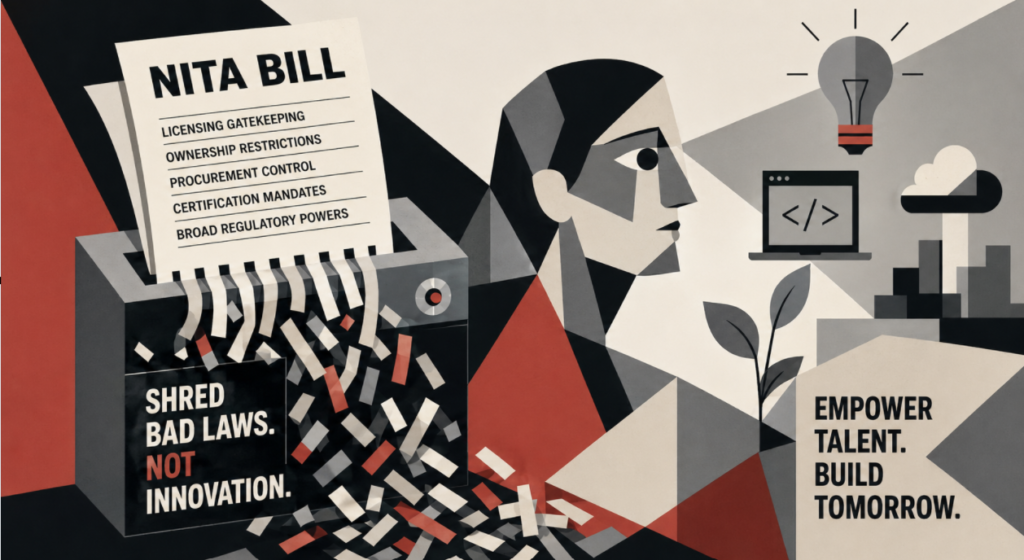
The Draft NITA Bill Should be Shredded

One of Ghana’s veteran business journalists, now based in New York, reached out and asked if I have been following the NITA bill debate. Sadly, I hadn’t. Too much going on. He pressed, subtly but firmly, so I did. I appreciate the ambition of the current management at the Ministry. I am sure they want their names in neon above Black Star Square. But there is a serious katanomicodour blowing from the bill they are promoting. They would do well to assemble a group of truly independent tech folks from the ICT chamber, not just a bunch of their friends, listen hard, talk less, and take the advice. If they did, they would gut that manuscript and return to the drawing board. Here is why, based on my quick take on the bill. Bottom line The Ministry of Communications, Digital Technology, & Innovations (MOC) does not merely appear to be proposing to “license IT professionals.” The draft NITA Bill is much bigger. The plan is to convert NITA from a coordinating ICT agency into a broad digital-sector regulator with powers over ICT infrastructure, cloud, SaaS, digital platforms, public-sector technology procurement, professional certification, business premises, mergers, ownership, standards, audits, sanctions, and even the structure of government digital infrastructure. It is a wholesale revamp. No one would have quarrelled with the bill if it had focused on the big problems in the sector: public sector procurement indiscipline and a lack of incentives for R&D and support for local tech innovations. Ghana certainly needs improved standards and practices in digital assurance, interoperability, and accountability for critical systems (already captured in the “critical infrastructure” policy). The katanomics arise when instead of learning from national mistakes and proposing workable solutions, one jumps the process to venture into a whole range of areas where the country absolutely lack policy experience. 1. MOC’s Proposals The draft/consultation bill proposes as follows: A stronger NITA “Authority” The Bill would establish NITA as a regulatory authority for ICT and digital services, with objects including regulation, coordination, promotion, standards, licensing, certification, interoperability, digital innovation, and public-sector ICT personnel management. Mandatory licensing of ICT business activity Section 35 (the bombshell that has sparked so much controversy). It says no person may engage in business or a related activity in the ICT sector unless granted a licence. It expressly includes installation of ICT infrastructure, development or provision of ICT products and services, and activities requiring licensing or certification. Doing any of these without a license could get one jailed, or at best fined. Who is to be licensed? Section 36 lists categories such as public/commercial ICT infrastructure, cloud hosting, SaaS providers, government digital services partnerships, national digital platform operators, data centre operators, and any other category the Authority later determines. Citizen-only ownership qualification Section 37 says a licence applicant must be an adult Ghanaian citizen, or a company/partnership/association/body “wholly owned by a citizen.” Essentially, it would now be illegal to engage remote experts to work on a system deployed in Ghana. Essentially, half the whiz kids in Silicon Valley would have been ineligible to build their genius gizmos had America had a law like this. Certification of ICT professionals Section 46 says a person shall not be appointed as an ICT professional in a public or private institution unless certified by the Authority, and that NITA shall determine the criteria and procedure. (Funnily, this contradicts the definitions section where “certified professional” is confined to the public sector.) Closure, seizure, suspension and enforcement powers  NITA could close premises or facilities, seize ICT products/equipment, suspend business, revoke licences, and impose administrative penalties in specified circumstances. M&A and business-structure control  Section 49 appears to require NITA approval before sale, transfer, merger, amalgamation, or alteration of the nature of an ICT service provider’s business. There are also some less controversial proposals about setting up a special purpose national e-government vehicle, promoting transparency and interoperability, and preventing vendor lock-in. Let’s focus, however, on the areas of the Bill that have rankled so many ICT professionals and would clearly not have seen the light of the day if the Ministry bosses had done any serious sounding beyond their clique. 2. What do they mean by “ICT professional” anyway? “IT/ICT professional” is not like “nurse,” “electrician,” “lawyer,” “chartered accountant,” or “professional engineer.” Those occupations usually have a more defined body of practice, recognised training path, public-risk rationale, and a reserved act or protected title. “ICT” and “IT” are very loose umbrella terms. International occupational systems do not treat ICT as one unified profession. The International Standard Classification of Occupations classifies jobs by skill level and specialisation, not by one vague “IT professional” identity. Eurostat and O*NET both list many distinct computer and mathematical occupations within that bracket: software developers, network architects, cybersecurity analysts, database administrators, web developers, data scientists, support specialists, QA testers, IT project managers, and many more. Is the government of Ghana going to insist on licensing every single person in Ghana who builds a website, uses Microsoft Power BI to create some charts for a company, or deploys mermaid to craft some flyers for an event organiser? The whole idea is totally ridiculous. A more sensible approach would be to pry open the ICT chest open and only target the most critical functions. Example: Critical Public Digital Infrastructure management (with a clear and rigorous process properly defined as to how any system gets to be elevated to that status to begin with); Financial services cybersecurity auditing; Tier II & III datacenter operations; Public hospital digital health network administration; Public ERP procurement readiness certtification. The bill could then have said that for those functions, licensed professionals are required. The licensing regime would then have been constructed in an industry-led fashion much like we have in leading accounting jurisdictions. Frankly, the civil service is the last place to situate licensing for a dynamic sector like ICT. More importantly, under no circumstances should any government aspire to poke its long nose into stuff like “writing code,” “installing a router,”


Vivian Kai Lokko, Editorial Lead - Business Outlook Africa
Opinion

When Revenue Collection Hurts Business

When outspoken politician and businessman Kennedy Agyapong, during an outreach engagement in the Central Region in December 2025, said the Ghana Revenue Authority (GRA) must stop intimidating entrepreneurs and instead support job creation, he struck a nerve. “The GRA should stop treating Ghanaian businessmen like criminals. When people try to build companies in this country, they go through too much frustration. How do we expect to create jobs when the very institutions meant to help are scaring business owners?” The NPP presidential hopeful is not alone. Similar concerns have been raised before. In 2024, during an interaction with members of the Ghana Chamber of Commerce and Industry, Vice President Dr. Mahamudu Bawumia also accused the Authority of harassing businesses under the guise of tax collection. According to Dr. Bawumia, the problem lies in the GRA’s practice of setting unrealistic revenue targets for its officers — a situation that results in overtaxing existing businesses instead of expanding the tax base. “They are harassing businesses. That harassment is coming from the sort of targets that are created at their office. They are setting unrealistic targets. Because the tax base is narrow, officers are given monthly targets and are left wondering where to find the money.” “So they return to the same taxpayers — people already paying — and come up with new reasons for them to pay more.” But beyond the politics and soundbites, one question matters most: How do Ghanaian businesses actually feel about the GRA’s impact on their survival and growth? To find out, Business Outlook with Vivian Kai Lokko put the question directly to the public across its social media platforms. The responses reveal a story that goes far deeper than a simple for-or-against tax debate.   The Verdict from the Polls Across LinkedIn, X (Twitter), TikTok, and Instagram, one message stood out clearly: many businesses feel more pressure than support. LinkedIn — a platform dominated by professionals and formal business operators — showed a more nuanced response: • 56% say the GRA is hurting businesses • 33% say it is both helping and hurting • 11% believe it is helping On X (Twitter), opinions were split and uncertain: • 38% say hurting • 38% say both helping and hurting • 19% are not sure • 6% say helping However, on platforms closer to everyday business activity and informal enterprise, the verdict was far less mixed. TikTok • 79% say hurting • 21% say helping Instagram • 100% say hurting   What the Data Really Tells Us This is not a tax-rejection poll. It is a lived-experience poll. The closer respondents are to daily cash-flow pressures, informal trading, and survival-driven entrepreneurship, the more negative their perception of the GRA becomes. Platforms like Instagram and TikTok — home to micro-entrepreneurs, traders, creatives, and side hustlers — delivered the harshest verdicts. Meanwhile, LinkedIn users, often salaried professionals or operators within the formal sector, acknowledged the importance of taxation but still expressed deep frustration. The message is clear: the problem is not taxation itself — it is how tax enforcement is experienced.   Supportive or Punitive? That’s the Real Debate Businesses are not arguing against paying taxes. They are questioning whether the system: • understands their cash-flow realities, • supports growth during difficult economic cycles, and • treats them as partners in development rather than targets for extraction. When compliance feels intimidating instead of enabling, the cost is not just frustration — it is slower growth, job losses, and discouraged entrepreneurship. As of 2024, SMEs in Ghana contributed about 70% of GDP and accounted for roughly 92% of all businesses — making their survival a national economic priority.   Why This Matters for Ghana’s Economy Small and medium-sized enterprises are the backbone of Ghana’s economy. They create jobs, drive innovation, and sustain communities. If these businesses consistently feel pressured rather than supported, the long-term consequences go far beyond tax revenue. A tax system that works must do two things at once: collect revenue efficiently and build trust with the businesses that generate that revenue. Right now, trust appears to be the missing link.   The Bottom Line Kennedy Agyapong’s comments may have reignited the conversation, but the polls suggest the issue is far bigger than politics. For many Ghanaian businesses, the real question is not: “Should we pay taxes?” It is: “Does the system help us survive long enough to pay them?” Until that gap is addressed, the perception of the GRA — fair or not — will continue to tilt toward hurting rather than helping. ⸻ By: Vivian Kai Lokko

Vivian Kai Lokko, Editorial Lead - Business Outlook Africa
Opinion

How Ghana’s Fuel Underdogs Became Market Leaders

For decades, Ghana’s downstream petroleum industry followed a familiar script. A few dominant brands controlled the pumps, set the tone on quality, and commanded fierce customer loyalty. Local oil marketing companies (OMCs) operated on the fringes—present, but rarely powerful. That story has now been shattered. Over the past five years, Ghana’s petrol and diesel market has undergone a quiet but seismic shift. Competition has intensified, market leadership has changed hands, and indigenous OMCs—once dismissed are now driving the industry’s most dramatic gains. Consumers are paying less at the pump and a new generation of local champions has emerged. This transformation did not happen by chance. It was triggered by regulation, sharpened by competition, and sustained by investment in quality. Breaking the ‘poor quality’ myth For years, smaller indigenous OMCs battled a stubborn stigma—that their fuel was inferior, adulterated, or unreliable. Today, that perception is rapidly fading. Many local players have invested heavily in quality control, logistics, and supply chain discipline—and the payoff is visible. Zen Petroleum stands out as a powerful example. Its diesel meets ultra-low sulphur European specifications, specially imported for the mining sector. Once unthinkable for a local brand, this level of quality is now becoming a competitive weapon. Regulatory enforcement has also played a crucial role. In 2012, the National Petroleum Authority (NPA), the industry’s regulator introduced the Fuel Marking Program to combat adulteration by tracking chemical concentrations in fuel. Tests results from inspections conducted at retail outlets following the introduction of the fuel marking program showed a failure rate of about 30%. By the end of 2025, this had reduced to just 2 percent a turnaround that has restored consumer confidence. The great market shake-up Nothing illustrates the industry’s transformation more clearly than the numbers. In August 2020, GOIL towered over the petrol market, selling more than 27 million litres in a single month. It was followed by Vivo, Total, Q8, and Zoe Petroleum. Indigenous brands like Star Oil, Zen, and Benab trailed far behind—important, but not dominant. Five years later, the hierarchy has been flipped. According to NPA data for January to November 2025 (RON 91 petrol): * Star Oil surged to the top, selling over 422 million litres * GOIL followed with 241 million litres * Vivo recorded 209 million litres * Total sold 147 million litres * Zen Petroleum broke into the top five with 102 million litres Star Oil—once outside the top ten—has overtaken Goil the long-time market leader. Zen has leapt from ninth place into the industry’s elite – top 5. It is a stunning reversal few would have predicted just half a decade ago. Behind them, a new wave of local competitors—Benab, Dukes, IBM, Frimps, and Allied Oil—is closing the gap. Others, including JP and Icon though not yet in the top ten, are winning customers with sharply competitive pricing that often undercuts even the biggest brands. How local players cracked the code Over the years, foreign-owned OMCs and GOIL dominated through deep pockets, aggressive advertising, and entrenched brand loyalty. That advantage is no longer guaranteed. Local OMCs have become deliberate and strategic—investing in: * Bold rebranding and station upgrades * Heavy visibility on social media * Loyalty schemes and promotions * Cleaner, more modern stations * Aggressive but targeted pricing * Improved incentives for franchise operators The result is a shift in perception. Middle-class consumers, once skeptical, are now willing to switch—and stay. Policy winds at their backs Government policy has accelerated this transformation. The move to full deregulation created a more level playing field, allowing price competition and operational flexibility. Then, in October 2024, Parliament passed Ghana’s Local Content Law, restricting OMC ownership to Ghanaians. Only legacy operators—Puma, TotalEnergies, Vivo Energy and So Energy were exempted, having existed before the law came into force. For local companies, the message was clear: this market now belongs to them. The hidden cost of a price war Yet success has brought new tensions. Intense competition has triggered a fuel price war, driven by selective price reductions that favour highly competitive urban centres. Rural and less competitive areas despite contributing equally to the Unified Petroleum Pricing Fund (UPPF)—often pay more. The Institute for Energy Security (IES) warns that this trend undermines Ghana’s Price Uniformity Policy and weakens the very mechanism designed to protect vulnerable consumers. Other stakeholders argue the competition is becoming unhealthy and insist Price Floor Regulation introduced in 2024 to check this must not be abolished. A new era, new questions Ghana’s downstream petroleum sector is no longer defined by legacy dominance or foreign control. Indigenous OMCs have rewritten the rules—through quality, branding, and ruthless competition. The next challenge is clear: how to sustain this momentum without sacrificing fairness, stability, and national cohesion. – By Vivian Kai Lokko