
Business Outlook Africa

Special Features

Special Features

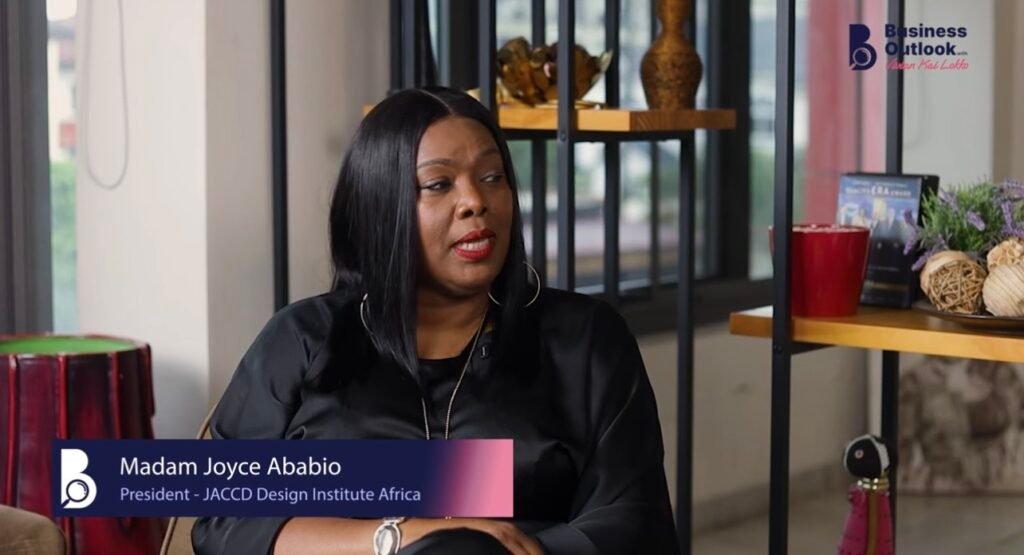
Ghana’s TVET Programme Is Producing Certified But Unskilled Fashion Workers – Joyce Ababio

The President of JACCD Design Institute Africa, Madam Joyce Ababio, has raised concerns about the quality of training being produced under Ghana’s TVET programme, arguing that its competency-based structure is churning out graduates who are certified but not skilled.   Speaking exclusively to Business Outlook Africa, Madam Ababio argued that by the time a trainee completes the early proficiency levels, they have yet to touch any practical aspect of the work, meaning those who exit at that stage enter the industry without the hands-on knowledge the job demands. She then advocated for the structure to be changed so that the students can get proper education and training to ensure they know more about the work once they are done with the program.   “ You see, when the TVET programme, for instance, it’s a competency-based training. And it goes through you doing proficiency one to proficiency two, to certificate one, to certificate two, to HND, to BTEC. By the time you are at BTEC, it’s like you have a degree.Do you understand? So when you pick people when you teach them proficiency one and proficiency two, you haven’t even touched any part of the work at all. Not at all. So when you say I’m done, these people are not skilled workers.They don’t know anything at all. And that is what we need to work towards, getting them proper training so that they know the work to do.” She stated   Madam Ababio further highlighted access to finance as another major obstacle, noting that designers and manufacturers in the industry struggle to secure loans and when they do, the high cost of interest from banks makes borrowing an additional burden rather than a solution.   “And also finding funding, finance. We cannot get alone to do these things.The banks, the cost of interest, crazy. It’s also something else. ” She added   Madam Ababio then noted that,despite the challenges when the right policy interventions are made, the country has everything it takes to become a dominant force in the global fashion industry. Watch full interview here:

Special Features

Sokoban Carpentry Chairman Calls for Reinstatement of Collapsed Banks to Ease Credit Burden on Artisans

Chairman of the Sokoban Wood Village Carpenters Association, Daniel K. Dagodzo is calling on government and regulatory bodies to reinstate the licenses of banks collapsed during Ghana’s 2017-2019 banking sector cleanup, arguing that their absence has severely limited affordable credit access for small-scale artisans. Speaking exclusively to Business Outlook Africa, Dagodzo traced the credit crisis facing artisans to the decimation of Ghana’s banking landscape, explaining that when there were more banks, competition drove interest rates down and made loans more accessible. But with fewer institutions now in the market due to the sector cleanup, that advantage has disappeared. “At first they were a lot of banks, but just some years ago, under the former President, the Central Bank and regulators revoked the license of many banks, but they were actually the ones helping us with saving and also because they were a lot, it brought about a healthy competition and it helped us because the interest rate when it came to interest on loans there were a lot of competitive alternatives for us the names.” He stated Beyond trade concerns, Dagodzo raised a land dispute threatening the association’s future. According to him, a plot of land secured by the Presidency some years ago at Asago for the association’s development and expansion has allegedly been taken over by a local chief who according to him ,is now selling portions to individuals. He noted that all available avenues for redress have been exhausted, with the association even facing harassment from landguards deployed to the site. “ Our last plea is that Presidency secured a land to develop for us some time ago, at Asago, to help us expand but the Chief has currently claimed ownership of the land and is selling to individuals to build on, we’ve tried all possible means but to no avail. They even brought landguards to harass us so we are pleading with the government to please come to our aid.”

Special Features

Sokoban Wood Village Carpentry Chairman Warns Galamsey Could Force Ghana to Import Timber

Chairman of the Sokoban Wood Village Carpenters Association, Daniel K. Dagodzo is sounding the alarm over Ghana’s galamsey menace , warning that if left unchecked, the country could one day be forced to import the very wood growing in its own forests. Speaking exclusively to Business Outlook Africa, Dagodzo argued that the dire consequences of galamsey extend far beyond destroyed water bodies, warning that the rate at which Ghana’s forests and trees are being decimated could one day force the country to import timber despite having the land to produce it. “ They’ve claimed most of these trees and it benefits to us all .If care is not taken, it is the exact same thing that will have that we will have our own land and still be importing timber/wood. So the govt should do well to avoid this.’’ He stated Daniel K. Dagodzo also called on government to direct sawmills to retain more timber locally, warning that reckless exports are leaving local carpenters with no option but to work with rejected and low-quality wood. He added that the more timber is exported, the less is available for local craftsmen, crippling both productivity and the quality of output at the village. “ You rarely get the quality ones. We even compete to get them. We are not saying they shouldn’t export the wood but we are telling them that when they do, they should retain more in the country, so that we can use it to produce quality work for them.’’ he stated On the increasing rate of deforestation, Dagodzo urged government to go a step further by designating a national tree-planting day to mobilize all Ghanaians in tackling the crisis head-on. He also stated that the association is open to collaborating with the Forestry Commission to plant more trees, warning that the growing shortage of wood is threatening the survival of the carpentry trade. “ The Government in particular should allow us to collaborate with the Forestry Commission to plant more trees or better still the Forestry Commission should set aside a date for all Ghanaians and the whole Ghana to plant trees so as to deal with wood shortage.’’ He added

Special Features

Wood vs Metal: Sokoban Carpenters Push Back Against Government’s School Furniture Switch

Chairman of the Sokoban Wood Village Carpenters Association, Daniel K. Dagodzo is calling on government to consider revising its decision to switch to the use of metallic furniture in our schools from the use of wooden made furniture in our schools. Speaking exclusively to Business Outlook Africa on the challenges the association faces in its day to day operations, Dagodzo argued that the government’s decision to switch has not only served a severe blow to their trade but has also stripped the village of its primary purpose. “But recently what’s making our work go down, is that the government has taken some steps that although its good, in some usage it’s not helping us the carpenters and our work. The one I can point out clearly is our school furniture. Of late we have realized the govt uses metals for making school furniture. Some time ago they did it, used the same approach but it didn’t help. Because of their decision to resort to metal tables, chairs and furniture, we don’t really get to see/fully utilize this place.’’he stated He added that the use of wooden furniture in our schools is not only good for durability purposes but also good because compared the the metal furniture, it’s a much safer options for particularly school use and can serve multiple purposes. “The students themselves complained, when we also went to some schools ourselves, we realized all the furniture made with metals that the govt got for them were all spoilt. I went to the University Primary and saw many there. When we use the wooden ones it helps the students and it doesn’t injure them or put their health at risk. We all know how students can behave sometimes. One time I visited a certain school, and one student was injured because his brother had pushed him and he landed on the metal and got hurt badly but I believe if it was a wooden furniture, because of how its shaped, he would not get hurt. The metal also has its use but it shouldn’t be used for school furniture. The wood has many purposes, if its used for school furniture and it spoils, it can even be used as firewood in the kitchen to cook for the students. But you can’t say same for metals.” he added On the rising rate of unemployment in the country, Dagodzo believes Ghana’s education system must shift from certificates to competence calling for a practical and skills-based curriculum to be introduced from an early age. “Exactly, in our time we used to have special time set aside for practical education and skill based learning. Some did carpentry, some were taken to the sea, some to the forest etc to observe and learn. This was all part of our education way back. So they should reintroduce this and set aside a day for all these things so that we can better equip our students, so that if even after school they are not employed by government, they can do something for themselves. If you look at today, after school most people don’t know what they are doing but if we introduce things like this for them at an early age. They will from a younger age start creating things by themselves.” He explained This follows President Mahama’s directive issued on June 5, 2025, ordering a switch from wooden to plastic or metal furniture in public schools. The policy, though not yet fully implemented, is anchored on conservation with the Presidency arguing that reducing commercial demand for timber will help curb the indiscriminate felling of trees.

Special Features

ARE ONION TRADERS BEING PRICED OUT BY GHANA’S BANKS?

  At Kumasi’s Anloga Onion Market, traders say 22–33% interest on business loans is not financing — it is a death sentence As Ghana debates high interest rates at the national level, traders at one of the country’s busiest onion markets say the reality on the ground is far more brutal. At Anloga Onion Market in Kumasi, small importers say commercial bank loans look attractive on paper but are suffocating their businesses in practice — and many have simply stopped trying. Hamidu Abdullahi, an advisor at the market, puts it plainly. “When we go to the banks, the interest they charge is too much for us so we don’t usually want to use their services,” he said. “When you go for a loan, the interest they charge might overwhelm you and leave you in debt — and the sad thing is, they will end up harassing your wife or family members.” The Numbers Don’t Add Up Commercial banks in Ghana charge between 22% and 33% on business loans. For onion importers operating on thin margins, traders say those rates are already difficult to absorb. But the deeper frustration is not just the cost , it is the timing. Onion importers travel supply routes that can stretch up to a month. By the time they return, offload their stock, and collect payment from retailers, their loan repayment window has already closed. “We also don’t like bank loans because of the duration — how lengthy the journey is,” Abdullahi said. “At times you’ll go for a loan and by the time you undertake the journey and come back, the repayment is already due so it doesn’t help.” He is asking banks to extend repayment periods or allow instalments. “The journey is not a small one. It can take up to a month and by the time you’re back, you now have to give the goods to traders for them to sell and give you your money, then you go and repay. It is not an easy one.” A National Conversation, A Local Reality The frustration at Anloga sits within a wider national debate. The Concerned Farmers Association of Ghana has previously pushed for interest rates as low as 2% for farmers. President John Mahama has called for single-digit lending rates to boost production. Under the 24-Hour Economy agenda, government plans to introduce SME loans ranging from 8% to 12%, in collaboration with the Bank of Ghana and the Development Bank Ghana. But at Anloga, traders say they are yet to feel any of that impact. Instead, many survive on personal savings, informal credit, and trust-based arrangements with suppliers — a fragile system that leaves little room for error and no cushion when a shipment is delayed or prices fall. Survival, Not Expansion For these traders, the ask is not complicated. It is affordable rates, flexible repayment terms, and credit that understands how their trade actually works. Because at 30% interest with a rigid repayment window, expansion becomes a luxury. Survival becomes the only goal.