Business Outlook Africa

Banking & Finance

Banking & Finance

BoG and SEC Warn Virtual Asset Providers Against Unauthorised Promotions

The Bank of Ghana (BoG) and the Securities and Exchange Commission (SEC) have cautioned Virtual Asset Service Providers (VASPs) against mass marketing and public promotional campaigns for virtual assets, unless explicitly authorised by the regulators. In a joint statement released on Friday, 20th February 2026, the two regulators in the financial market explained that the directive is aimed at addressing growing concerns over the increasing advertisement of virtual assets and stablecoins. This includes the use of large billboards in Accra and other parts of the country by some VASPs. The statement also noted that virtual asset advocacy is a regulated activity requiring registration by both the BoG and SEC with detailed rules on advocacy and advertising to be soon issued in due course. VASPs who have already erected billboards or other public advertisements are also instructed to remove them within 48 hours of the notice. The regulators warned that failure to comply will attract strict sanctions. This directive forms part of broader efforts to ensure consumer protection, maintain financial stability, and promote responsible innovation within Ghana’s emerging virtual asset ecosystem.          

Mr. Mensah Thompson, Deputy Director-General, Operations at the Securities and Exchange Commission (SEC)
Banking & Finance

SEC Reaffirms Commitment to Regulated Virtual Asset Ecosystem in Ghana

The Deputy Director-General, Operations at the Securities and Exchange Commission (SEC), Mr. Mensah Thompson, has reiterated the Commission’s commitment to building a credible and well-regulated virtual asset ecosystem in Ghana at the Ghana Virtual Assets & Financial Services Symposium held on 17th February 2026 at the Mövenpick Ambassador Hotel, Accra. In his keynote address, Mr. Thompson highlighted ongoing regulatory measures, including the development of Guidelines for Digital and Online Foreign Exchange Trading Activities and the operationalisation of the Virtual Asset Service Providers Act, 2025. “Regulatory clarity is not an obstacle to growth. It is the foundation of sustainable growth,” he stated. He noted that the SEC is finalising a Regulatory Sandbox framework and strengthening supervisory and enforcement actions to protect investors and uphold market integrity. The Deputy Director-General also emphasised collaboration with the Bank of Ghana and other stakeholders, including implementation of a National Virtual Asset Literacy Programme and compliance with global AML/CFT standards. He reaffirmed that the SEC remains committed to fostering innovation within a framework of trust, transparency and financial stability.   Source: Securities and Exchange Commission (SEC), Ghana

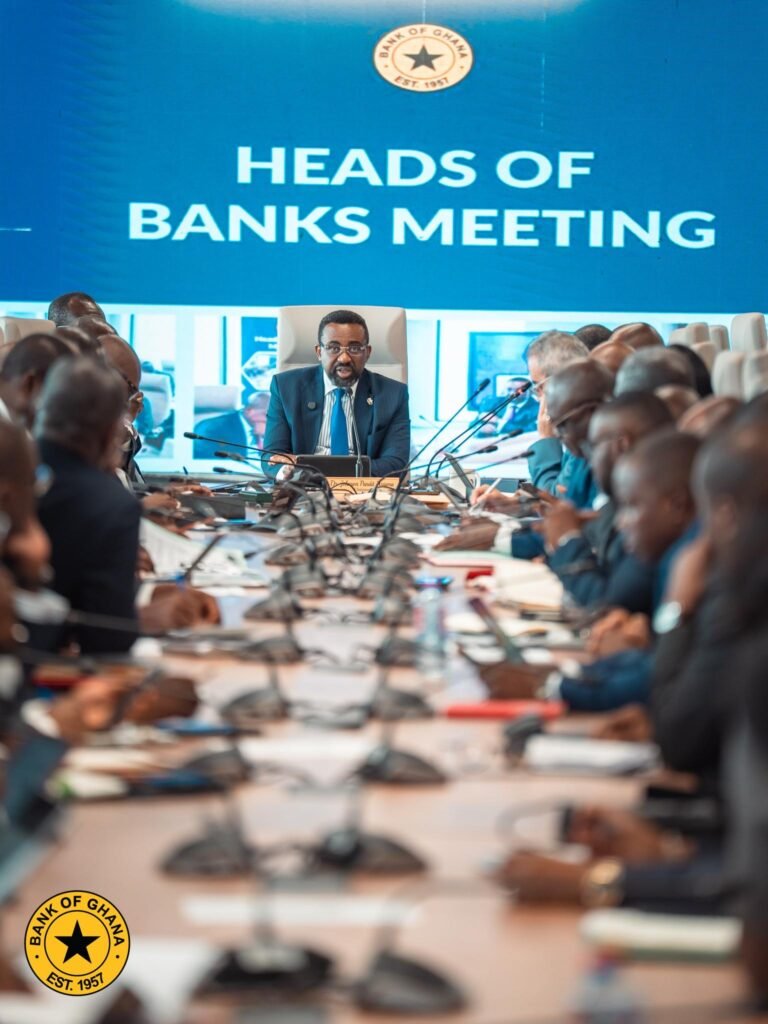
Dr. Johnson Pandit Asiama ,Governor, Bank Of Ghana
Banking & Finance

Dr. Asiama Calls for Structural Strengthening and Disciplined Lending in Ghana’s Banks

The Governor of the Bank of Ghana, Dr. Johnson Pandit Asiama, has outlined a new phase for Ghana’s banking sector, urging institutions to move beyond recovery and focus on structural strengthening to support long-term economic growth. Speaking at the Post-MPC Engagement with the Heads of Banks, Dr. Asiama stated that with improved macroeconomic stability,the sector must now not only prioritise structural reforms and stronger institutional foundations but also prioritise durability through stronger business models, broader ownership and disciplined innovation. “Colleagues, with macroeconomic stability improving and regulatory reliefs now behind us, the conversation must shift from resilience to structure. Stability has been restored. The task ahead is to strengthen the underlying architecture of the banking sector. The task now is durability. Durability requires stronger business models, broader ownership, deeper intermediation, disciplined innovation, and sound governance. The Bank of Ghana will continue to engage as a firm, fair, and forward-looking partner, supportive where necessary, but clear in its expectations.” He stated He also added that although non-performing loans are on the decline recently, they remain above benchmark levels, making disciplined lending critical as credit growth resumes. The Governor stressed that renewed lending must support productive sectors without undermining asset quality. “Similarly, while non-performing loans have declined, they remain above benchmark levels. As credit expansion resumes, underwriting discipline and sectoral risk assessment will be critical. Stability must now translate into purposeful intermediation, supporting agriculture, manufacturing, SMEs, and value-adding sectors, without reintroducing asset quality pressures.” Dr. Asiama also highlighted progress on financial sector reforms, noting that Ghana has enacted legislation to regulate digital asset activities. He said the focus has now shifted to implementing the framework and preparing institutions for the evolving digital finance landscape. “In addition, the Virtual Asset Service Providers Act has now been enacted, establishing a formal regulatory perimeter for digital asset activities in Ghana. The next phase is operationalisation. We are working on the regulatory frameworks, supervisory processes, and coordination mechanisms necessary to bring the Act fully into effect in a structured and orderly manner.” He then concluded that regulators and financial institutions share responsibility for strengthening the sector’s long-term foundations and ensuring it supports national development.


Banking & Finance

SEC Warns Public Against Unlicensed Investment Scheme ‘Mekanism’

The Securities and Exchange Commission (SEC), Ghana, has issued a public notice cautioning the general public against an unlicensed investment scheme operated by Mekanism Marketing Ltd, also known as “Mekanism.” In a statement released on the 16th of February, 2025, the commission stated clearly that Mekanism Marketing Ltd is not licensed, authorized, or approved to operate in Ghana’s capital market hence any investment activity promoted by the entity constitutes an unauthorized and illegal capital market operation. ”The SEC states unequivocally that Mekanism Marketing Ltd is NOT licensed, authorized, or approved to operate in Ghana’s capital market. Accordingly, any investment activity promoted by this entity constitutes an unauthorized and illegal capital market activity.” According to the SEC, the scheme allegedly uses social media and online platforms to solicit funds from the public, promising fixed daily returns described as “unrealistic” and “unsustainable.” Participants are reportedly required to perform unspecified tasks labeled “Job 1” to “Job 10” in order to earn income. The regulator further warned that operating without a valid license is a criminal offense under the Securities Industry Act, 2016 (Act 929) and the Companies Act, 2019 (Act 992). The commission then advised the public to exercise extreme caution and desist from investing in any product or scheme promoted by Mekanism. It added that it is collaborating with law enforcement agencies to identify and take appropriate action against individuals behind the operation.

Albert Essien, Former Group Managing Director of Ecobank
Banking & Finance

Fix Credit Risk or Repeat the Crisis — Albert Essien’s Warning to Ghana’s Banks

Former Group Managing Director of Ecobank, Albert Essien, has identified weak risk management — particularly credit risk — as the single biggest downside of Ghana’s banking sector. Reflecting on Ghana’s recent banking sector crisis, Mr Essien argued that the core challenge facing the industry is not regulatory compliance alone, but how effectively banks manage lending risk. According to him, while many bankers are well-trained in financial theory and risk analysis, sustainable banking requires more than technical knowledge. It requires character. “I think one of the biggest downsides for our bank sector is risk management — especially credit risk. It’s about learning the theory, yes, but also building the character,” he stated. Mr Essien noted that non-performing loans (NPLs) remain elevated — still hovering in the region of the 20 percent range — and questioned why the industry continues to struggle with credit quality. “We should ask ourselves why. How do we treat it? How do we reduce it? That is something the Institute should think about,” he said, urging professional bodies to convene experts and develop targeted programmes to address the persistent risk management gap. Beyond credit risk, the former banking executive warned that the sector is entering a new era defined by rapid automation and artificial intelligence. Having witnessed the transition from ledger books to spreadsheets, Essien says the next transformation is already underway. “We are in great automation. The future is about understanding how artificial intelligence will change the banking system,” he explained. He revealed that some financial institutions are already deploying algorithms to support lending decisions — a shift that demands new technical skills from bankers. “Banking will basically remain what it is — taking deposits, keeping some, lending some. But the mode of delivery is what is changing,” he added. His message is clear: Ghana’s banking sector must strengthen credit discipline, build ethical leadership, and embrace AI-driven innovation — or risk repeating the mistakes of the past.