
The Government of Ghana has announced a strong fiscal performance and broad-based macroeconomic turnaround for 2025, describing the period as one of the most significant economic turnarounds in the country’s recent history.
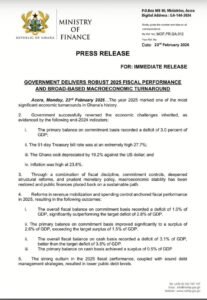
In a statement issued on Monday, February 23, 2026, authorities stated the economy bounced back following difficulties faced in 2024 such as inflation being as high as 23.8 percent , a primary balance deficit of 3.0 percent of GDP and a a 91-day Treasury bill rate of 27.7 percent.
Government attributed the economic turnaround to fiscal discipline, commitment controls, deepened structural reforms, and prudent monetary policy.
The statement indicated that the primary balance on a cash basis recorded a surplus of 0.5 percent of GDP, while the overall fiscal balance on the same basis posted a deficit of 3.1 percent of GDP. On a commitment basis, the primary balance improved to a surplus of 2.6 percent of GDP, with the overall fiscal balance registering a deficit of 1.0 percent of GDP. According to the statement, these outcomes were driven by reforms in revenue mobilisation and tighter expenditure control.
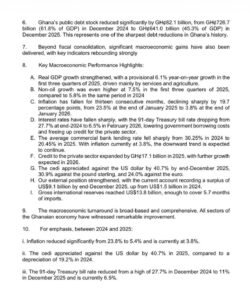
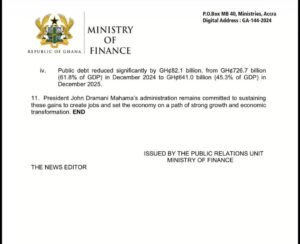
Adding to fiscal consolidation efforts, 2025 recorded one of the sharpest debt reductions in Ghana’s history, with public debt declining from GH¢726.7 billion in December 2024 to GH¢641.0 billion ,representing an 11.8 percent reduction.
Beyond fiscal consolidation, the statement also highlighted improvements in key macroeconomic indicators, including a provisional real GDP growth of 6.1 percent year-on-year in the first three quarters of 2025, stronger non-oil growth of 7.5 percent over the same period, and inflation easing to 3.8 percent by the end of January 2026. The period also saw a sharp decline in interest rates, with the 91-day Treasury bill rate dropping from 27.7 percent at end-2024 to 6.5 percent in February 2026, reducing government borrowing costs and freeing up credit for the private sector. The average commercial bank lending rate similarly fell from 30.25 percent in 2024 to 20.45 percent in 2025.
Credit to the private sector expanded by GH¢17.1 billion in 2025, with further growth expected in 2026. The Ghanaian cedi appreciated against major currencies, gaining 40.7 percent against the United States dollar, 30.9 percent against the Pound sterling, and 24.0 percent against the Euro by the end of December 2025. Ghana’s external position also strengthened, with the current account recording a surplus of US$9.1 billion, up from US$1.5 billion in 2024, while gross international reserves rose to US$13.8 billion which is enough to cover about 5.7 months of imports.
Government says it is committed to building on these achievements to create employment opportunities and support long-term economic growth and transformation.
About The Author
